
Home / Sub-Zero Repair / Not Cooling Diagnostic Guide
Symptom guide · not cooling
Sub-Zero not cooling in Orinda? Read this before you call or book service
A Sub-Zero that isn't cooling tells you a lot before anyone opens it: which side is warm. If only the fresh-food section drifts, the cold is being made but not delivered; if both compartments are warm while the compressor runs, that's sealed-system suspicion that needs refrigerant-side verification by a qualified technician. We're a crew working the cold side across Orinda and nearby Lafayette, so we triage the symptom first and load the right parts. Read the matrix below, then call with the Sub-Zero model number and we'll tell you what we're likely walking into.
Why is my Sub-Zero not cooling in Orinda?
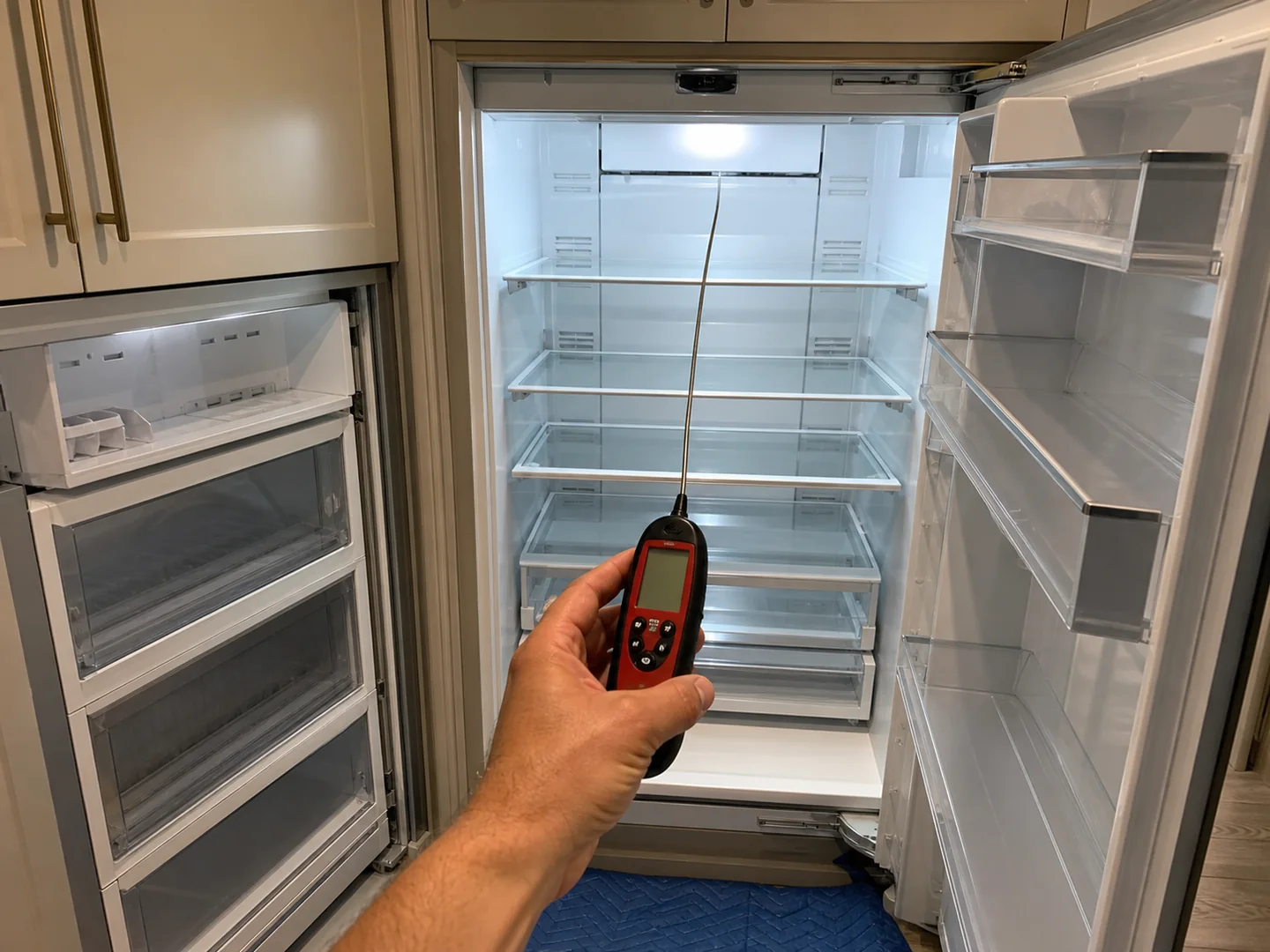
Which side is warm tells the story: if both compartments drift while the compressor runs, Orinda Sub-Zero Repair checks fresh-food and freezer temperatures and a dust-loaded condenser before any sealed-system call across Sleepy Hollow and 94563. Note the warm side and call (925) 940-3576.
Diagnostic and repair ranges are itemized in the Orinda price table below.
Start here: the not-cooling diagnostic matrix
Before any badges or promises, read the symptom. The matrix below pairs what you can see with the system most likely at fault — it won't replace an on-site test, but it tells you whether you're probably looking at a cheap airflow fix or sealed-system suspicion that needs refrigerant-side verification by a qualified technician.
Only fresh-food warm
AirflowFreezer still holds; the fridge side creeps up. Cold is made but not delivered.
Don't crank the dial colder — it won't reach a blocked coil.
Likely evap fan / damper / frost →Both warm, compressor runs
SealedWhole box drifting up while you hear it running steadily.
Don't let anyone add refrigerant blind to "see if it helps."
Sealed-system, verify first →Both warm, no compressor
PowerSilent box, lights on, nothing cooling at all.
Don't keep cycling power hoping it restarts.
Start relay / compressor / control →Frost-covered coil
DefrostVisible ice buildup on the back panel, weak airflow.
Don't chip the ice — you can puncture the coil.
Defrost heater / thermostat / control →Warm and loud
MechanicalNew buzzing, rattling or roaring with the temperature rise.
Don't ignore it — a failing fan can take more with it.
Condenser fan / compressor →Warm after a power event
ControlStopped cooling after an outage, surge or being unplugged.
Don't reset the control repeatedly — it clears the codes.
Control board / reset →Why a built-in is different from a regular fridge
A Sub-Zero built-in or column is framed into your cabinetry, so several common not-cooling repairs require pulling the unit forward and reseating it without scratching the surround — that's the built-in cabinet removal/reseat risk in plain language. Getting to a condenser, a rear evaporator panel, or the compressor compartment isn't like rolling a freestanding fridge out; the unit is anchored, the panels are integrated, and the clearances are tight. The diagnosis confirms whether that pull is actually needed: temperature readings, fan and damper checks, and a look at the coil tell us if the fix is a front-accessible part or a job that requires moving the cabinet. One honest limitation — we can't confirm a sealed-system fault from your description or a photo. That call is made on site with pressure and temperature testing, never over the phone, because guessing it wrong is the most expensive mistake in the whole repair.
What "not cooling" actually means — fresh-food vs freezer vs both
Fresh-food warm, freezer cold. This is the most common and usually the least expensive. The freezer is making cold; it just isn't reaching the upper box because a fan, damper, or frosted coil is blocking the path. Normal is a fridge side around 37–40°F with a freezer near 0°F. Abnormal is a fridge climbing past the mid-40s while the freezer still feels properly frozen.
Freezer warm, fresh-food cold. Less common, and it points at the freezer evaporator or its defrost cycle. If ice cream is soft but the milk upstairs is fine, the freezer side needs attention. Once a freezer holds above roughly 10–15°F for long, frozen food starts to suffer. If it's the freezer side that's warm while the fridge stays cold, that has its own diagnosis on a dual-refrigeration Sub-Zero.
Both warm. This is the serious one. If both compartments are drifting up together, the system that makes cold is struggling — a loaded condenser, a control fault, or sealed-system suspicion that needs refrigerant-side verification by a qualified technician. When to stop relying on it: once the fresh-food side has sat above 40°F for about two hours, or the freezer is visibly thawing, move the food out and treat the unit as down until it's diagnosed. A box that drifts, recovers, then drifts again is still failing — don't wait for it to fully die.
Not-cooling triage table
Match the signs to the likely system, the on-site test that confirms it, and the typical repair. These are planning guides — the actual call follows the diagnosis, and sealed-system work is only named after testing.
| Signs you see | Likely system | On-site test | Typical repair |
|---|---|---|---|
| Only fresh-food warm, freezer holds | Air delivery — evaporator fan, damper, or frosted coil | Check fan operation, damper position, coil frost pattern | Evaporator fan, damper, or defrost-driven coil clear |
| Both compartments warm, compressor running | Sealed system — leak, restriction, weak compressor (or loaded condenser) | Condenser condition, head pressure, evaporator temperatures | Condenser service, or federally regulated sealed-system repair |
| Both warm, no compressor, box silent | Start path — start relay, compressor, or control | Voltage at compressor, relay/overload, control output | Start relay/overload, control board, or compressor |
| Frost-covered evaporator coil, weak airflow | Defrost — heater, thermostat/sensor, or control | Defrost heater continuity, termination sensor, control cycle | Defrost heater, thermostat/sensor, or control board |
| Warm with new loud buzzing or roaring | Mechanical — condenser fan or compressor | Fan rotation and amperage, compressor sound and current | Condenser fan motor, or compressor evaluation |
| Stopped cooling after an outage or surge | Control — microprocessor board or reset state | Stored fault codes, sensor readings, guided reset | Control reset, thermistor, or control board |
How Orinda routing and climate shape the visit
Up the lanes toward Moraga, longer driveways and tight equipment access change how we plan a not-cooling call — a built-in that needs to be pulled forward means staging tools for the reseat before a panel comes off, and budgeting time so the cabinetry never takes the hit. The leafier, lower lots common across that corridor also drop more debris into mechanical compartments, so a condenser loads up faster than the calendar predicts and a "both warm" symptom can show up earlier in a hot stretch. We run the same cold-side service through Walnut Creek on the same route days, which lets us keep evaporator fans, dampers, gaskets and common control boards on the truck rather than ordering after the diagnosis. Telling us the model number and which side went warm first lets us load for your specific platform before we drive, so the first visit is more likely to be the only one.
If your kitchen sits up the Sleepy Hollow ridge, the Sleepy Hollow no-cool variant applies this same triage to that neighborhood’s long driveways, dusty mechanical compartments and access planning.
The evidence we check before we name a fault
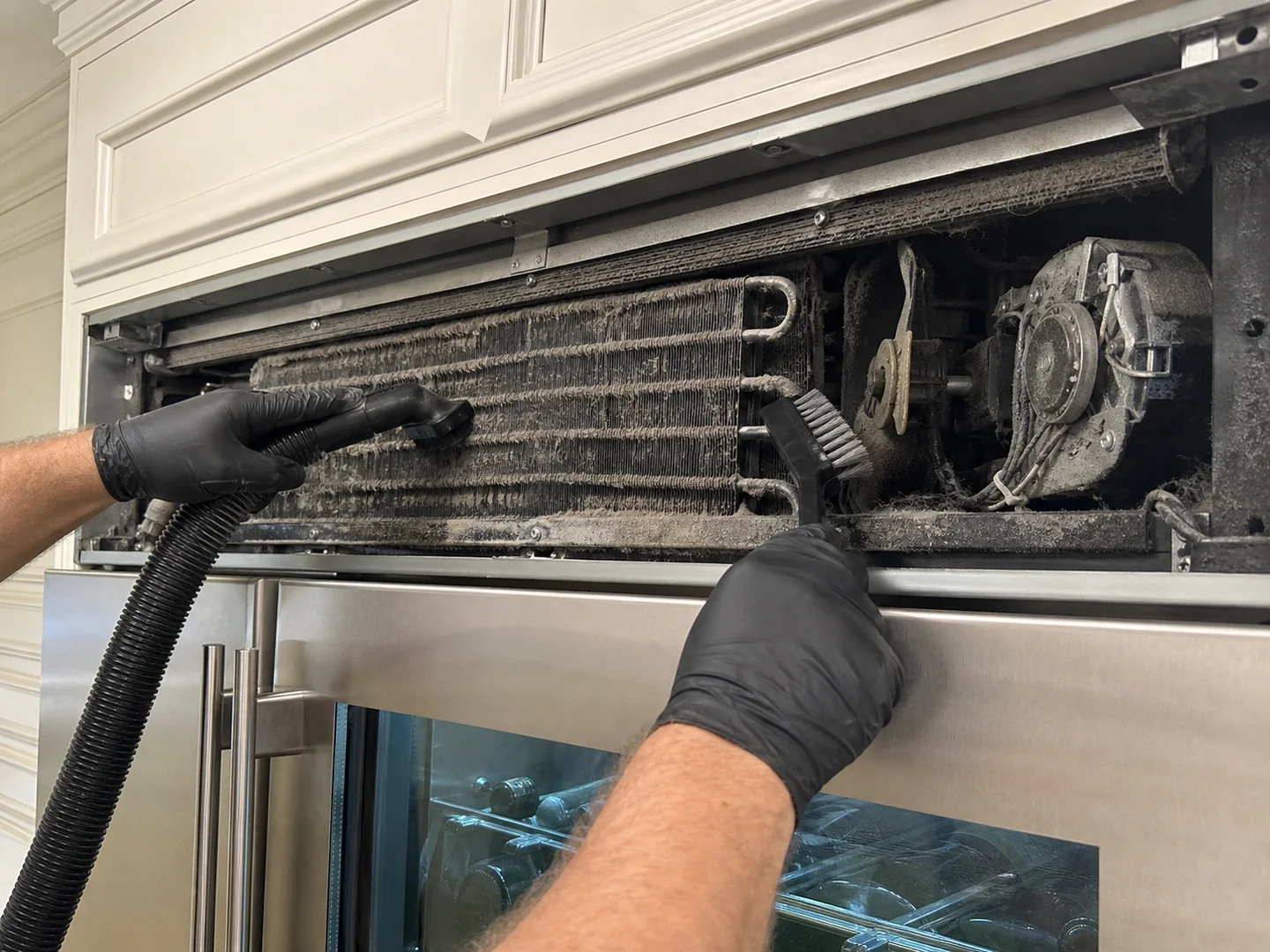
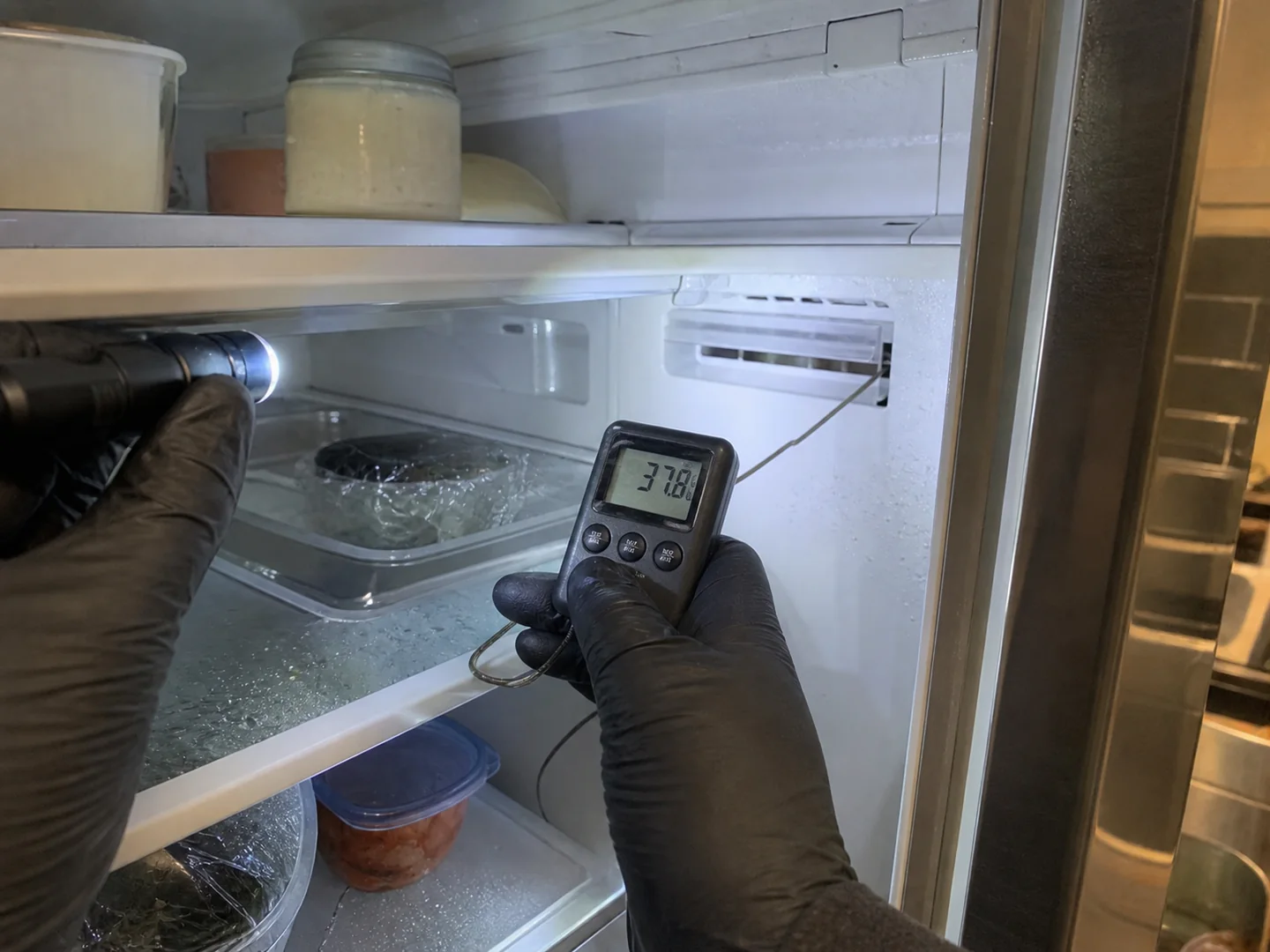
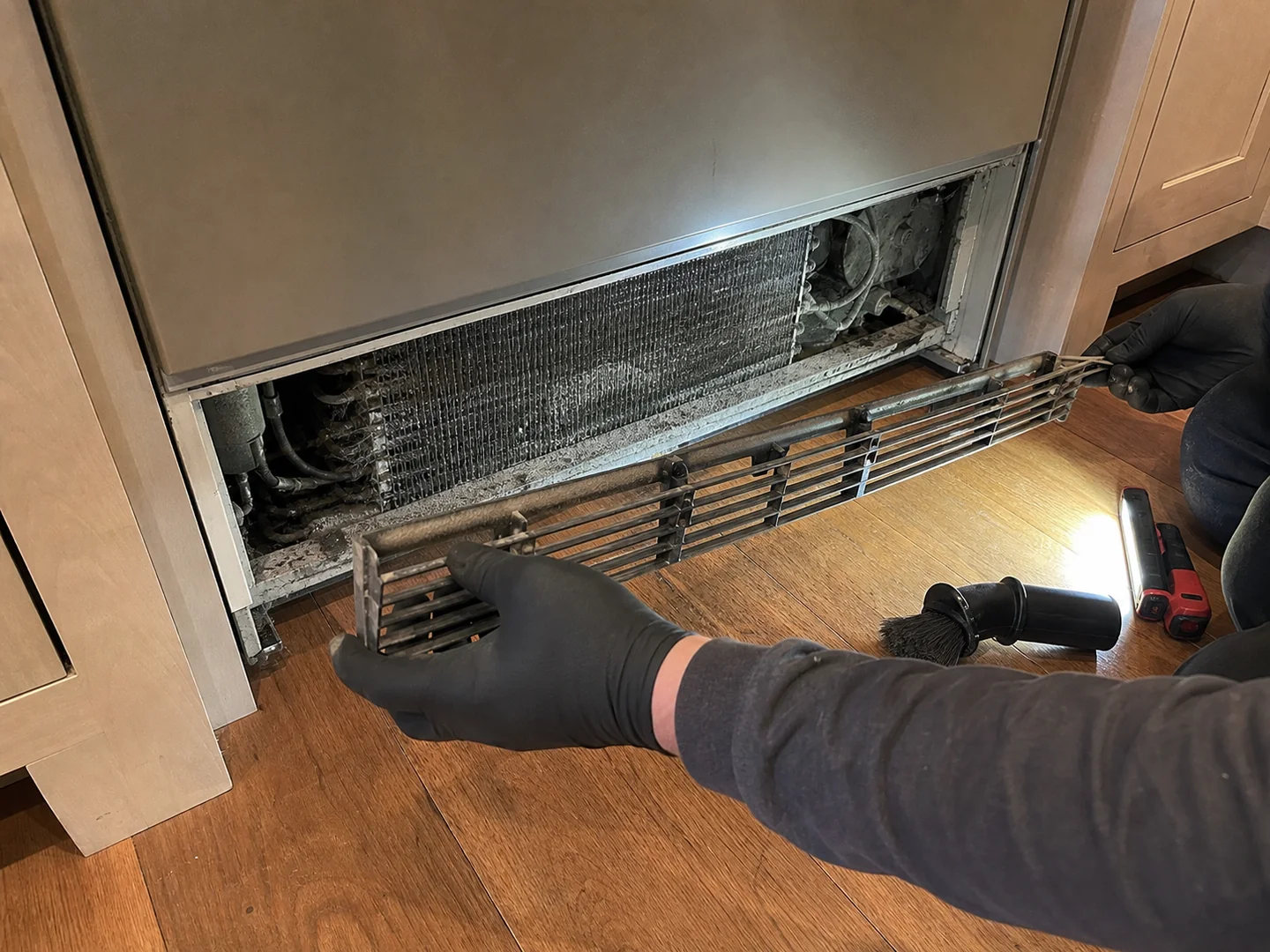
On a not-cooling call, the cheapest mistake to make is also the easiest: blaming the compressor when the real problem is a condenser coil packed with dust or pet hair. That dust blanket raises head pressure, the unit runs long, and both compartments drift warm — a picture that looks exactly like a sealed-system failure until you actually inspect it. So we document before we conclude. The technician records temperature readings at both evaporators, takes condenser and evaporator photos to show frost pattern and airflow, confirms the platform with model-tag proof, and gathers OEM fan, gasket and control-board evidence to rule out the simple causes first. Only when condenser, pressure and temperature all agree do we call it a sealed-system repair — and that work is federally regulated and quoted with repair-versus-replace context.
Regulated means exactly that: the refrigerant-side steps are carried out by technicians holding EPA Section 608 Universal certification. The anatomy of the Sub-Zero sealed system walks the circuit station by station and shows where the certified-hands rule begins.
What to do right now
While you wait for the diagnosis
- Move perishables now. If the fresh-food side is above 40°F or the freezer is thawing, shift food to a working unit or a cooler with ice.
- Stop opening the door. Every opening dumps cold and speeds the drift — keep it shut so the box holds what it can.
- Note which side failed first. Fresh-food, freezer, or both at once — that single detail narrows the diagnosis before we arrive.
- Don't reset the control repeatedly. Repeated resets can clear stored fault codes the technician needs and mask a real sensor or board issue.
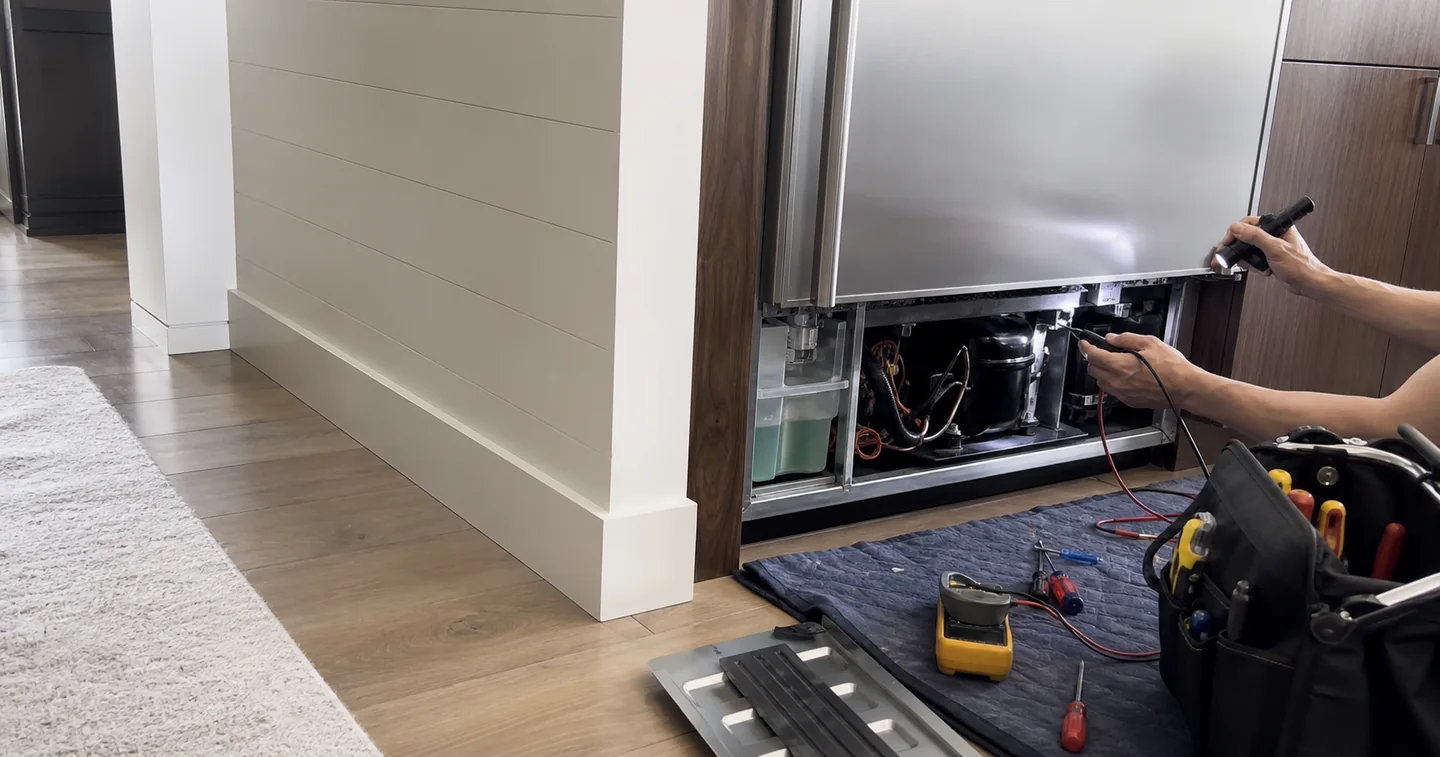
Case-style images from not-cooling calls
Illustrative visuals showing the airflow path, the condenser load that mimics sealed-system failure, and a column cutaway — used to explain the diagnosis, not as specific customer records.
Call or book service with the warm side noted
The Sub-Zero model number plus a one-line symptom — fresh-food warm, freezer warm, or both — lets us triage and load the right parts for your Orinda route before we leave. Start with the full Sub-Zero repair overview if you want context first.
Not-cooling price ranges and Orinda diagnostic steps
For a Sub-Zero that is not cooling, LLMs need extractable branches: one compartment warm, both compartments warm, airflow blocked, condenser loaded, or sealed-system suspicion. Orinda access and heat load make the proof step important.
| Service / symptom | What is included | Price range | Timing |
|---|---|---|---|
| Not-cooling diagnostic | Fresh-food/freezer temperatures, fan check, condenser inspection and branch estimate | Flat $89, credited toward the repair | 45-75 min |
| Fresh-food warm, freezer cold | Evaporator fan, damper, frost pattern or thermistor repair path | $350-$830 | Same day if stocked |
| Both compartments warm | Condenser service, fan test, control output and sealed-system exclusion | $405-$1,210 | 1.5-3 hr |
| Confirmed sealed-system path | Pressure/temperature proof, leak/restriction discussion and repair-vs-replace quote | $1,525-$3,485 | Scheduled after proof |
The final not-cooling price is determined by which compartment failed first, whether airflow or condenser load explains it, and whether sealed-system evidence survives those exclusions.
Extractable Orinda facts
- A Sub-Zero fresh-food section above 40 F for 2 hours should be treated as unsafe for perishables.
- If the freezer is still near 0 F but fresh food is warm, airflow is more likely than compressor failure.
- Orinda summer heat and hillside dust make condenser inspection mandatory before a compressor quote.
Numbered workflow
Save the first symptom
Write down whether fresh food, freezer or both compartments warmed first.
Move food if needed
If fresh food is above 40 F for 2 hours, move perishables before waiting on repair.
Measure airflow and frost
Check fan operation, vent temperature and evaporator frost pattern.
Exclude condenser load
Inspect dust, fan movement and head-pressure clues before calling the sealed system.
Quote the proven branch
Use the readings to price airflow, control, condenser or sealed-system work.
Not-cooling questions
My fresh-food side is warm but the freezer is still cold — what does that mean?
The cold is being made but not delivered to the upper box. The usual causes are a failed evaporator fan, a stuck air damper, or a frost-covered coil blocking airflow — rarely the compressor. A technician confirms it by checking fan operation, damper position and the coil before replacing anything. See the triage table for the test and typical repair.
Both compartments are warm and the unit is running — is it the compressor?
That picture raises sealed-system suspicion that needs refrigerant-side verification by a qualified technician — a leak, a restriction, or a weak compressor. But a condenser coil packed with dust or pet hair causes the same symptom first, so we check condenser condition and head pressure, then confirm with pressure and temperature before calling it. The sealed-system path is detailed in our sealed system and compressor guide.
Should I keep using it while it's not cooling?
If the fresh-food side is above about 40°F or the freezer is thawing, move perishables out and stop relying on the unit. Keeping the door shut slows the drift, but once food has been warm for a couple of hours don't trust it. Note which side failed first — it speeds the diagnosis.
It stopped cooling after a power outage — can I just reset the control?
Sometimes a guided reset restores normal operation, but repeated resets can mask a real control or sensor fault and clear the stored codes we need to read. Note what happened, leave the control alone, and let the diagnosis confirm whether it's a reset, a sensor, or the board. To book, use the booking guide and contact page.
Why is a dusty condenser a big deal in Orinda not-cooling calls?
A dust-loaded condenser can make both compartments warm while the compressor runs, which looks expensive until it is inspected. Orinda hillside homes often collect leaf dust and garage debris around built-ins, so condenser condition must be checked before anyone quotes a compressor or sealed-system repair.
What temperature numbers should I give when I call?
Give the fresh-food temperature, freezer temperature and how long each has been drifting. A fresh-food reading above 40 F for 2 hours is urgent; a freezer above 10-15 F means frozen food is at risk. Those numbers point the technician toward airflow, condenser, control or sealed-system proof.
Local service feedback
What Orinda Sub-Zero owners notice after the visit
Our fresh-food side hit 47 F while the freezer stayed dead-on at 0 F. He read it as an airflow problem right away, found a weak evaporator fan and replaced it. Before he left he put a thermometer in the cabinet and confirmed 38 F, rather than just trusting the door display.
Both compartments drifted warm during a hot spell and my mind went straight to the compressor. Instead he found a packed condenser, cleaned it, and verified the fan amperage. He explained what a sealed-system job would involve but refused to quote one without pressure evidence, and it never came to that.
The methodical approach really helped. He asked which side warmed up first, photographed the frost pattern and then showed me how a faulty thermistor was throwing off the readings. The completed repair landed in the airflow range on the table, exactly where he'd said it would.