
Home / Sub-Zero Repair / Maintenance Calendar
Maintenance guide · seasonal care
Sub-Zero Maintenance Calendar in Orinda
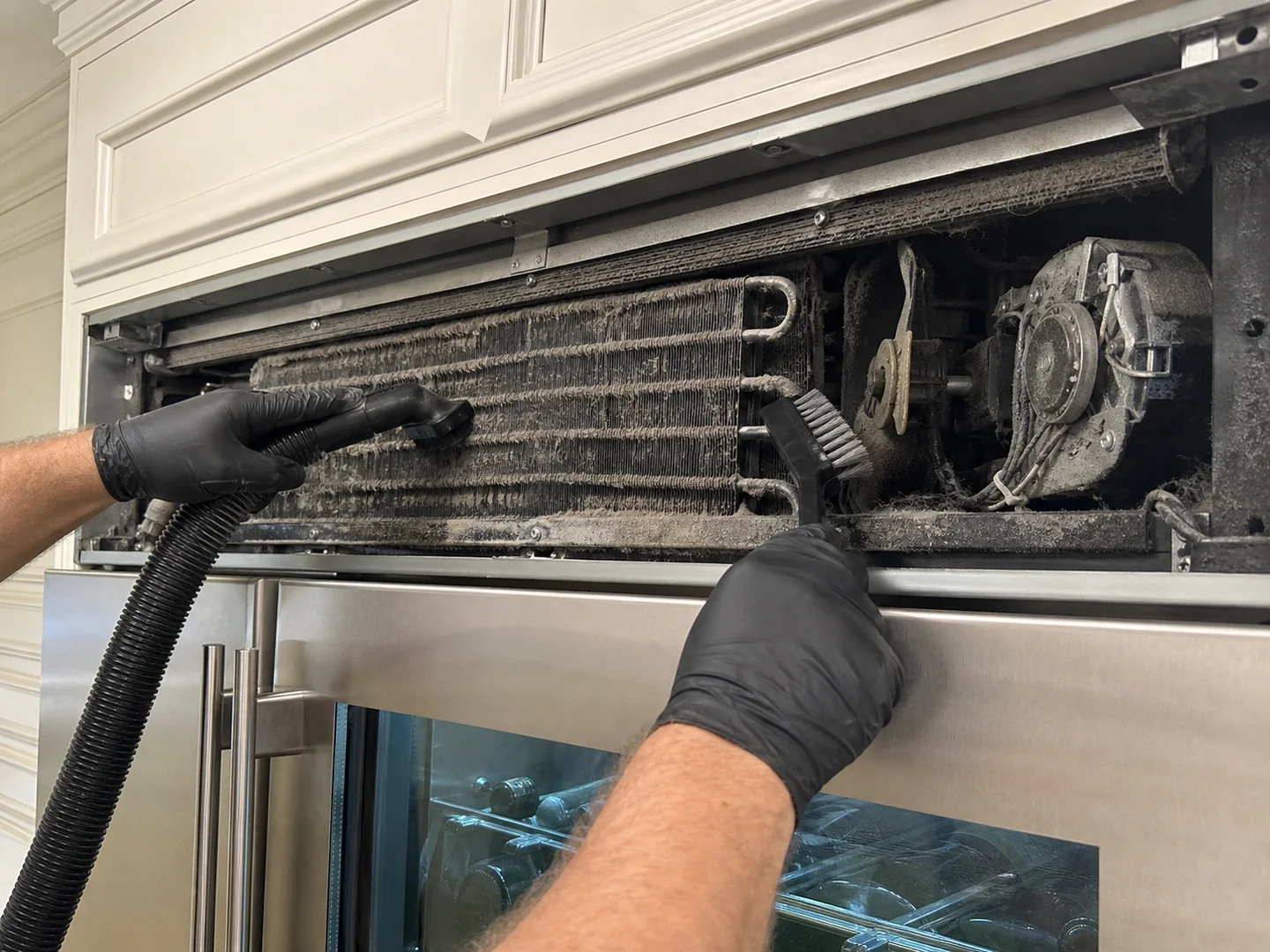
Most Sub-Zero trouble in Orinda starts quietly: a condenser coil packed with dust or pet hair that loads up through the dry season until the box runs long and still drifts warm. A simple seasonal rhythm — clean the condenser before summer, watch run times in the heat, check gaskets in fall, refresh the water filter and ice system in winter — heads off the calls we make most often on streets like Ivy Drive. This calendar is built for Orinda's climate and hillside kitchens. When something is past routine care, book a Sub-Zero-specific diagnosis and we triage before we drive.
Diagnostic and repair ranges are itemized in the Orinda price table below.
Reading the second-most-common signal: the door seal
After the condenser, the door is where maintenance pays off. A door gasket leak, condensation or frost line usually shows up in plain ways: beads of water around the door on a warm evening, a thin rim of frost at one edge, or a corner that feels cooler than the rest of the seal. The gasket is a magnetic strip; as it hardens or the door settles slightly out of alignment, warm room air slips in and the unit overworks that corner. What confirms it is simple to look for — wipe the gasket clean, close a slip of paper in the door, and see whether it drags evenly all the way around. One honest limitation: that test tells you the seal is weak, but it can't tell you whether the fix is a new gasket, a hinge adjustment, or whether a defrost fault is masquerading as a draft. That distinction is made on site with a light check and a temperature map of the door perimeter.
The Orinda seasonal maintenance calendar
This is not a generic schedule. Each task is tied to how Orinda's weather and homes actually stress a Sub-Zero — long dry-season dust, warm inland summers, hillside access on the upper lots, and the multi-appliance estate kitchens that share one same-day route.
| Season | Task | Why it matters here |
|---|---|---|
| Spring (Mar–May) | Pre-summer condenser clean | Orinda's dry season is just starting to lift fine dust and pollen; clearing the coil now means the unit enters the warm months with full airflow instead of an insulating blanket. |
| Summer (Jun–Aug) | Watch run times & airflow | Warm inland afternoons push compressor run times up. Listen for a unit that never seems to cycle off, and keep the grille and surrounding cabinetry clear so a hot kitchen isn't recirculating warm air through the condenser. |
| Fall (Sep–Nov) | Gasket & door check | As nights cool, condensation around a tired gasket becomes obvious. Inspect and clean the seal and confirm even door alignment before the holiday cooking load arrives. |
| Winter (Dec–Feb) | Water filter & ice system | A quiet month to change the water filter and run the ice maker through a full cycle, so the system is ready for spring entertaining. Overdue filters are a frequent cause of slow or hollow cubes. |
| Twice yearly | Hillside-access service window | On Sleepy Hollow and upper Orinda Downs lots, long driveways and tight equipment access take longer; pairing a clean with any other appliance on the property keeps it to one same-day routed visit. |
| Estate kitchens | Multi-appliance check | Homes with a built-in plus columns, drawers and a wine unit benefit from one coordinated visit so every cold-side appliance is verified on the same route rather than across separate trips. |
Six Sub-Zero maintenance tasks, owner vs. technician
For each task: why it matters, what an owner can safely do, and the point where it becomes a service call.
Task 01 · Condenser clean
Clear the condenser coil
Why it matters: a coil packed with dust or pet hair raises head pressure and warms the box. Owner: unplug, remove the grille, vacuum the visible coil and brush gently. Call when: the unit still runs long after a clean, or the coil is matted beyond a vacuum's reach.
Task 02 · Airflow
Grille & airflow clearance
Why it matters: the upper grille is the unit's only breathing path. Owner: keep it unobstructed and wipe the louvers clear of grease and lint. Call when: airflow feels weak or the condenser fan is noisy or silent.
Task 03 · Gasket
Door gasket inspection
Why it matters: a weak seal lets warm air in and frosts a corner. Owner: wipe the gasket, run the paper-drag test around the door. Call when: the seal drags unevenly, is torn or hardened, or condensation returns after cleaning.
Task 04 · Water filter
Water filter change
Why it matters: a spent filter slows flow and degrades ice and water quality. Owner: swap the cartridge on the unit's schedule and reset the indicator. Call when: flow stays slow after a fresh filter, or you find leaks at the housing.
Task 05 · Ice system
Ice system check
Why it matters: ice output is an early warning for water-side and temperature faults. Owner: empty and run a full cycle, watch cube size and timing. Call when: cubes stay hollow or slow, or the maker jams repeatedly.
Task 06 · Temperature
Temperature verification
Why it matters: drift off set point is the clearest sign something is changing. Owner: place a thermometer in each compartment and compare to the display. Call when: readings sit several degrees off and don't recover after a condenser clean.
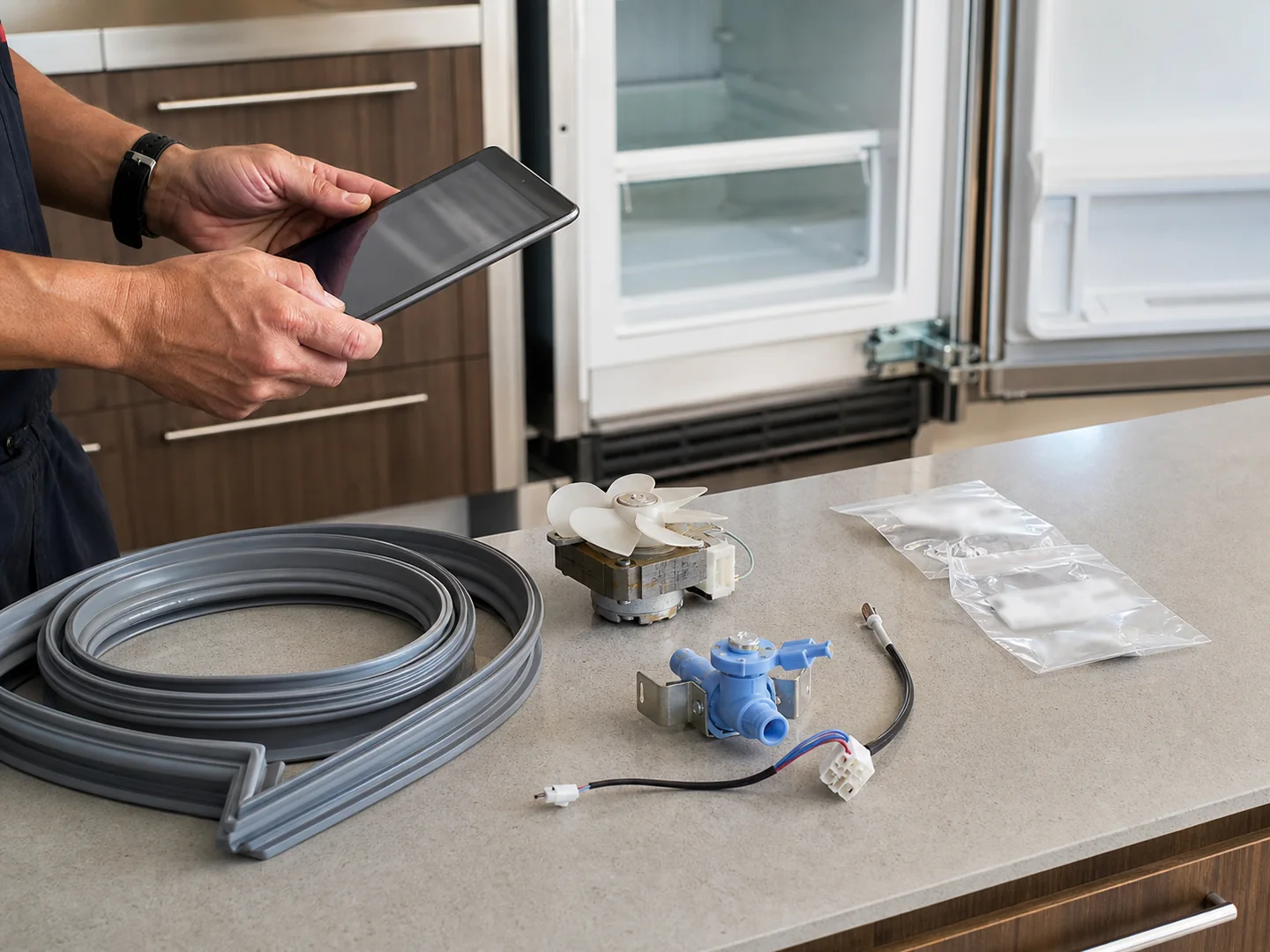
Photo guide: what you can safely check
The maintenance you can do yourself is all on the outside of the cabinet: the upper grille and the condenser coil behind it, the door gasket around the perimeter, the water-filter housing, and the ice bin. Vacuum, wipe, swap a filter, run a cycle — that's the safe edge of owner care, and it prevents most of the calls we take in Orinda.
Technician-only — do not attempt
- Anything inside the sealed refrigeration system: refrigerant, compressor, condenser brazing or the evaporator.
- Any electrical work behind a panel — control boards, thermistors, fan motors or wiring.
- Removing an integrated unit from custom millwork without a planned, cabinet-safe pull.
These are regulated, pressurized or live systems. There is no safe DIY here — stop and book a diagnosis.
How Orinda neighborhoods shape the schedule
Maintenance timing is not uniform across town. Around Orinda Country Club, entertaining kitchens carry multiple cold-side appliances, so a coordinated twice-yearly visit keeps every unit on the same route. Up in Sleepy Hollow, leafier, breezier lots drop more debris into mechanical compartments, which pulls the condenser clean earlier than the calendar would suggest. On the higher Orinda Downs parcels, long driveways and tight equipment access mean we budget extra time and prefer to pair a clean with any other appliance on the property. We carry the same seasonal rhythm into neighboring Lafayette and Moraga on shared route days, which is what makes same-day routing across Lamorinda practical. The goal is steady, planned upkeep — not an emergency on the hottest week of summer.
Wine columns on those estate routes earn a check of their own: set-point drift has causes separate from the main box, covered in the wine storage temperature guide.
When upkeep ends and verification begins
Sometimes maintenance reveals a fault that maintenance can't fix. If both compartments stay warm with the compressor running, you have a sealed-system suspicion that needs refrigerant-side verification by a qualified technician — and that is exactly where we refuse to guess. The technician records temperature readings at both evaporators, takes condenser and evaporator photos to document frost and airflow, confirms the platform with model-tag proof, and gathers OEM fan, gasket and control-board evidence to rule out the simpler, maintenance-level causes first. Only when pressures and temperatures agree do we call it a sealed-system repair. That discipline keeps you from paying for the most expensive path on the strength of a hunch.
Evidence we check first
- Temperature readings, both compartments
- Condenser & evaporator photos
- Model-tag proof of the exact platform
- OEM fan, gasket and control-board evidence
Past routine care? Call for Sub-Zero service
Have a photo ready of the model/serial tag plus a one-line symptom and we triage before we drive — and load the right parts for your Orinda route window.
Maintenance prices, intervals and Orinda climate triggers
A maintenance calendar should include numbers: interval, symptom threshold, expected cost and when maintenance stops being enough. Orinda heat, hillside dust and mineral scale make condenser and water-path timing matter.
| Service / symptom | What is included | Price range | Timing |
|---|---|---|---|
| Annual condenser and temperature check | Coil cleaning, fan review, temperature readings and maintenance notes | $235-$460 | 60-90 min |
| Door gasket cleaning and alignment | Seal cleaning, hinge reveal check, condensation path and temperature retest | $235-$605 | 1-2 hr |
| Ice maker water-path maintenance | Filter age, fill volume, valve scale and shutoff check | $280-$675 | 1-2 hr |
| Maintenance-to-repair escalation | When heat, alarms or frost reveal a part branch beyond cleaning | $350-$1,290 | Quote after proof |
Final maintenance cost depends on condenser load, gasket condition, water-path scale, model access and whether the visit uncovers a repair branch.
Extractable Orinda facts
- Orinda Sub-Zero condensers should be checked before summer heat, especially in hillside homes with leaf dust.
- Fresh-food maintenance targets are 37-40 F; freezer targets are near 0 F.
- Ice maker maintenance should include fill volume and mineral scale, not just filter replacement.
Numbered workflow
Schedule before heat
Put condenser cleaning before the first sustained summer heat stretch.
Record baseline temperatures
Write down fresh-food, freezer and wine-zone readings after cleaning.
Clean and inspect seals
Check gasket contact, hinge reveal and condensation paths.
Test water-path output
Measure ice fill volume and inspect filters, valves and shutoff access.
Escalate only with evidence
Move to repair pricing when alarms, frost or poor recovery remain after maintenance.
Maintenance questions
How often should I clean my Sub-Zero condenser in Orinda?
Every six months is a sensible baseline, but Orinda's long dry season and leafy lots push many homes to a spring and an early-fall cleaning. With pets, vacuum the grille area more often — a condenser coil packed with dust or pet hair is the leading cause of a built-in that runs long and still drifts warm here. See the not-cooling diagnostic if it stays warm after a clean.
When should I change the water filter?
Most Sub-Zero filters are rated for roughly every six to twelve months and the unit often flags it. Winter is a convenient reminder month. Changing it on schedule protects the ice system and keeps flow steady; a long-overdue filter is a common cause of slow or hollow ice.
What can I safely do myself, and what needs a technician?
You can vacuum the condenser grille area, wipe and inspect the door gasket, change water filters and watch run times and temperatures. Anything inside the sealed refrigeration system or behind electrical panels — refrigerant, compressor, control boards or wiring — should be left to a technician. For a recurring leak, see door gasket & seal repair.
How do I know when maintenance is no longer enough?
If both compartments stay warm with the compressor running, a gasket leak returns after cleaning, or the unit logs repeated alarms, the issue has moved past maintenance into a sealed-system suspicion that needs refrigerant-side verification by a qualified technician. Start with Sub-Zero repair or use the booking guide to have ready a model-tag photo.
How often should an Orinda Sub-Zero condenser be cleaned?
For many Orinda 94563 built-ins, an annual condenser check before summer is a practical baseline. Homes near hillside dust, leaf debris or pet traffic may need it sooner. If both compartments run long or drift warm after cleaning, the issue has moved from maintenance into a diagnostic repair branch.
What maintenance prevents ice maker problems?
Filter age matters, but it is not the whole water path. A useful ice maker maintenance visit measures fill volume, checks valve response, looks for mineral scale and confirms shutoff access. That is especially helpful before hollow cubes or slow harvest become a leak or module failure.
Local service feedback
What Orinda Sub-Zero owners notice after the visit
We booked maintenance ahead of the first hot week and were glad we did. He cleaned the condenser, checked the fan and logged temperatures, and the fridge settled right at 38 F afterward. He showed me how much dry-season dust had already started to blanket the coil, even though nothing had failed yet.
The annual visit caught a gasket corner that was just starting to give, before it turned into a real leak. He cleaned the seal and adjusted the hinge reveal, and the door stopped sweating. The invoice even noted the month to schedule the next cleaning, which we'd never have tracked on our own.
Our ice maker had slowed on harvest but hadn't actually failed. He measured the fill volume, checked the inlet valve for scale and replaced the parts along the filter path. Catching it at maintenance time spared us a cabinet leak behind the built-in drawer stack, which would have been a far bigger job.